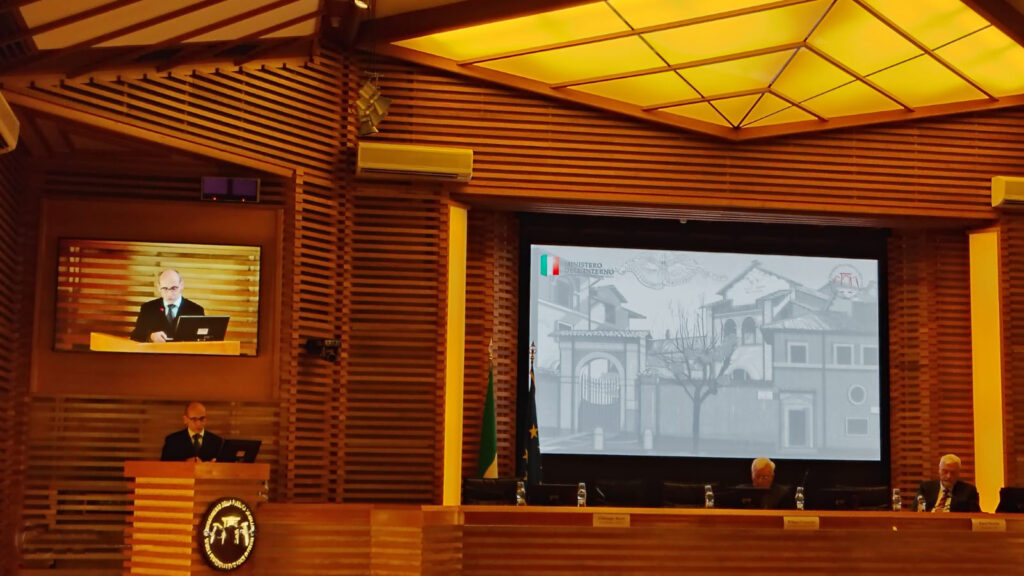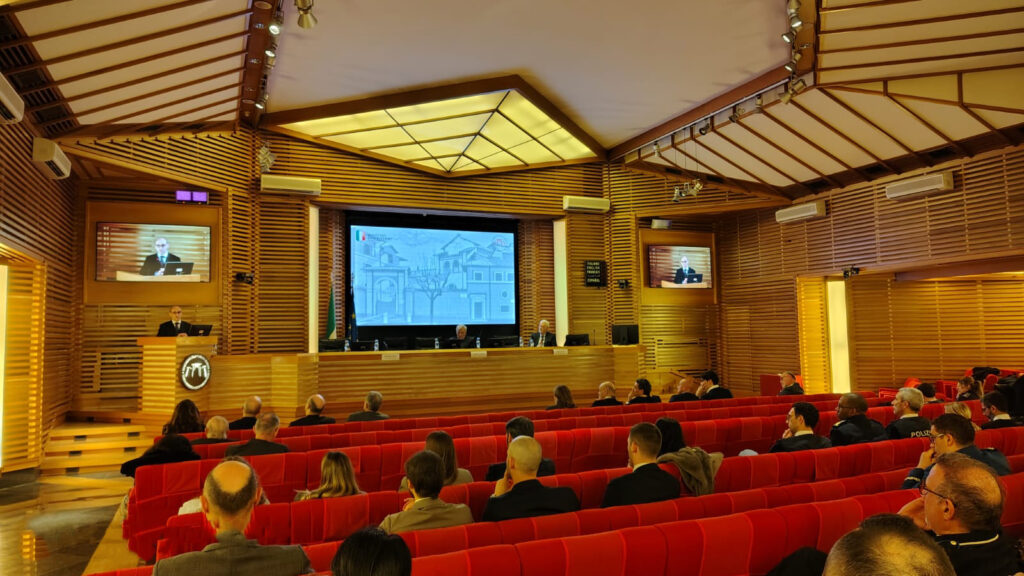
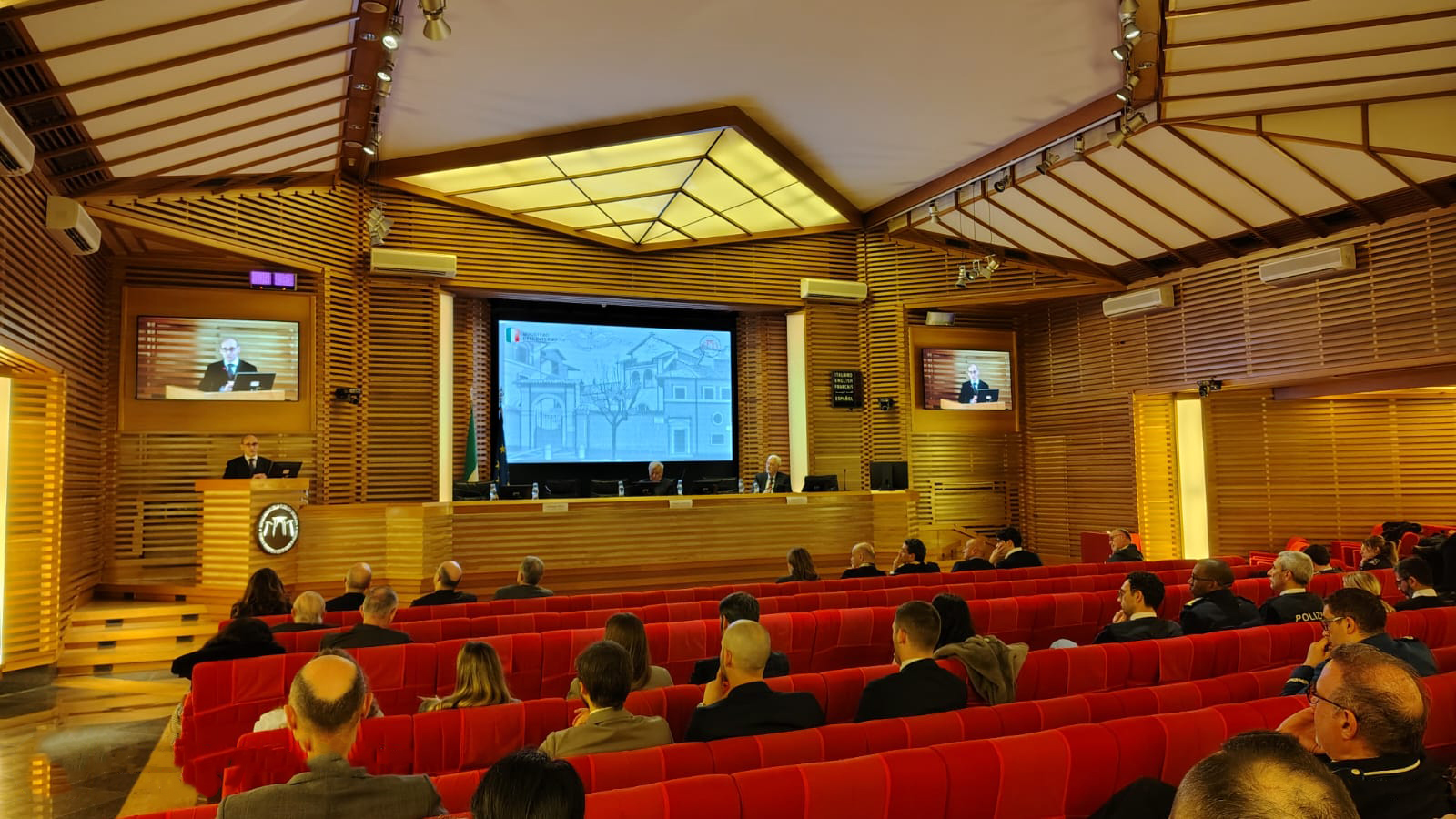
In the afternoon of 12 March 2026, the SFP Director, National Police Dirigente Generale Vincenzo Modeo, opened the session of the conference titled “Theoretical and operational approaches to prevent and counter corruption for the sake of public benefit”. This event, held at the venue of the “Carlo Mosca” Conference Hall, was organized as part of the activities of the Anti-Corruption Master’s Program at the Tor Vergata University of Rome.
In his opening remarks, Director Modeo emphasized that the fight against corruption is one of the main challenges facing democratic institutions today, since it requires a joint commitment from public administrations, the academic world and legal professionals. In this context, advanced training initiatives, such as the Master’s Program in Anti-Corruption, provide an important opportunity to have a scientific insight and establish dialogue among experts coming from different institutional and professional fields.
The Master’s program, addressed to newly graduates, professionals and employees in both the public and private sectors, is aimed at providing and enhancing interdisciplinary knowledge of systems used to prevent and counter corruption, thus making professionals capable of working within legislative bodies and decision-making processes at various levels of government, across different political, institutional, business and associative contexts. The goal is to train highly qualified professionals capable of interpreting and implementing complex anti-corruption legislation, as well as contributing to the dissemination of organizational models based on transparency, integrity and administrative accountability.
The conference’s introductory presentations were delivered by Mr. Giuseppe Busia, President of the National Anti-Corruption Authority (ANAC) and Mr. Enzo Serata, Director of the Financial Intelligence Unit for Italy (UIF).
President Busia highlighted, among other things, the central role of prevention policies and transparency tools in public procurement systems and the management of public resources. Moreover, he emphasized that corruption badly affects competition and undermines the principle of equality among citizens. Busia, who is a lawyer and a legal expert of public law, has led ANAC since 2020, after holding key positions at the Italian Data Protection Authority and the Public Contracts Supervisory Authority.
Mr. Serata, on the other hand, examined the topic concerning the fight against illegal financial flows and the strategic role of the analysis and prevention activities carried out by the Financial Intelligence Unit (UIF), thus highlighting how collaboration between financial institutions, supervisory authorities and investigative bodies represents a fundamental tool aimed at timely identifying corruption phenomena and suspicious transactions.
The topics addressed in the introductory presentations were subsequently analyzed and discussed during the roundtable that was held later. This initiative was coordinated and moderated by Professor Filippo Cucuccio, Director General of the National Association for the Study of Credit Issues.
Participants in the debate included Professor Emiliano Di Carlo, Director of the Anti-Corruption Master’s Program, Mrs. Francesca Palisi, Head of Legal and Tax Consulting at the Italian Banking Association, Brigadier General Giovanni Salerno, Commander of the Special Anti-Corruption Unit of the Guardia di Finanza Corps, Mr. Luca Guido Tescaroli, Chief Prosecutor of the Public Prosecutor’s Office of Prato and Mr. Antonino Turicchi, President of Autostrade per l’Italia Group.
During the discussion, participants examined in depth the various legal, administrative, and organizational tools through which institutions and the economic system can contribute to the prevention of corruption, with a special focus on the role of compliance models, internal control systems, the digitalization of administrative procedures and the strengthening of transparency mechanisms.
The conclusions of the session were presented by Professor Vittorio Capuzza of the Tor Vergata University of Rome, who emphasized the importance of a multidisciplinary approach to the analysis of corruption phenomena and highlighted how training and scientific research are essential tools to foster a culture of legality aimed at pursuing public benefit.